Why this route
This seven-day line is the full Northwest China loop: it links the plateau lake country around Qinghai Lake with the Silk Road desert frontier that gives Dunhuang its name, then returns through the Hexi Corridor fortress towns. Days 1 and 2 cover the lake half — Ta’er Monastery, Riyue Mountain, the Qinghai Daotang River scenic area, the Erlangjian scenic area and Heimahe Town, then Xiangpi Mountain, Chaka Salt Lake, the Delingha Alien Ruins scenic area and the Keluke Lake–Tosu Lake Nature Reserve. Days 3 and 4 are the Dunhuang core: the Han frontier sites of Yumen Pass, Hecang City and the Han Dynasty Great Wall ruins, the Yadan National Geological Park, then Mogao Grottoes, Mingsha Mountain, Crescent Moon Spring and the Shazhou Food Station heritage-snack night market.
The back half turns the route home through Gansu and the Qilian Mountains: Jiayuguan Pass alone on Day 5, Zhangye’s Rainbow Danxia scenic area, Dafo Temple and Mati Temple on Day 6, and a final scenic run over Zhuoer Mountain, the Qilian Mountain grasslands, the Menyuan rapeseed flower sea and Heiquan Reservoir on Day 7. The split does real work: two full days for the lakes and salt flats before the desert leg, two days for Dunhuang itself, and three single-focus days for the return, so the corridor and mountain stops never compete with the grottoes for attention.
Day by day
Day 1 — To Qinghai Lake. Open with 1.5 hours at Ta’er Monastery, then Riyue Mountain and the Qinghai Daotang River scenic area, neither of which carries a listed duration. The timed stops are the Erlangjian scenic area (1.5 hours) and Heimahe Town (1 hour), the day’s final stop.
Day 2 — Salt flats. Return to Heimahe Town for a longer two-hour stay, cross Xiangpi Mountain, then take two hours at Chaka Salt Lake. The Delingha Alien Ruins scenic area follows with no listed duration, and the day closes with one hour at the Keluke Lake–Tosu Lake Nature Reserve.
Day 3 — Han frontier. Yumen Pass, Hecang City and the Han Dynasty Great Wall ruins, all open-ended stops, lead to the day’s single timed visit: one hour at the Yadan National Geological Park.
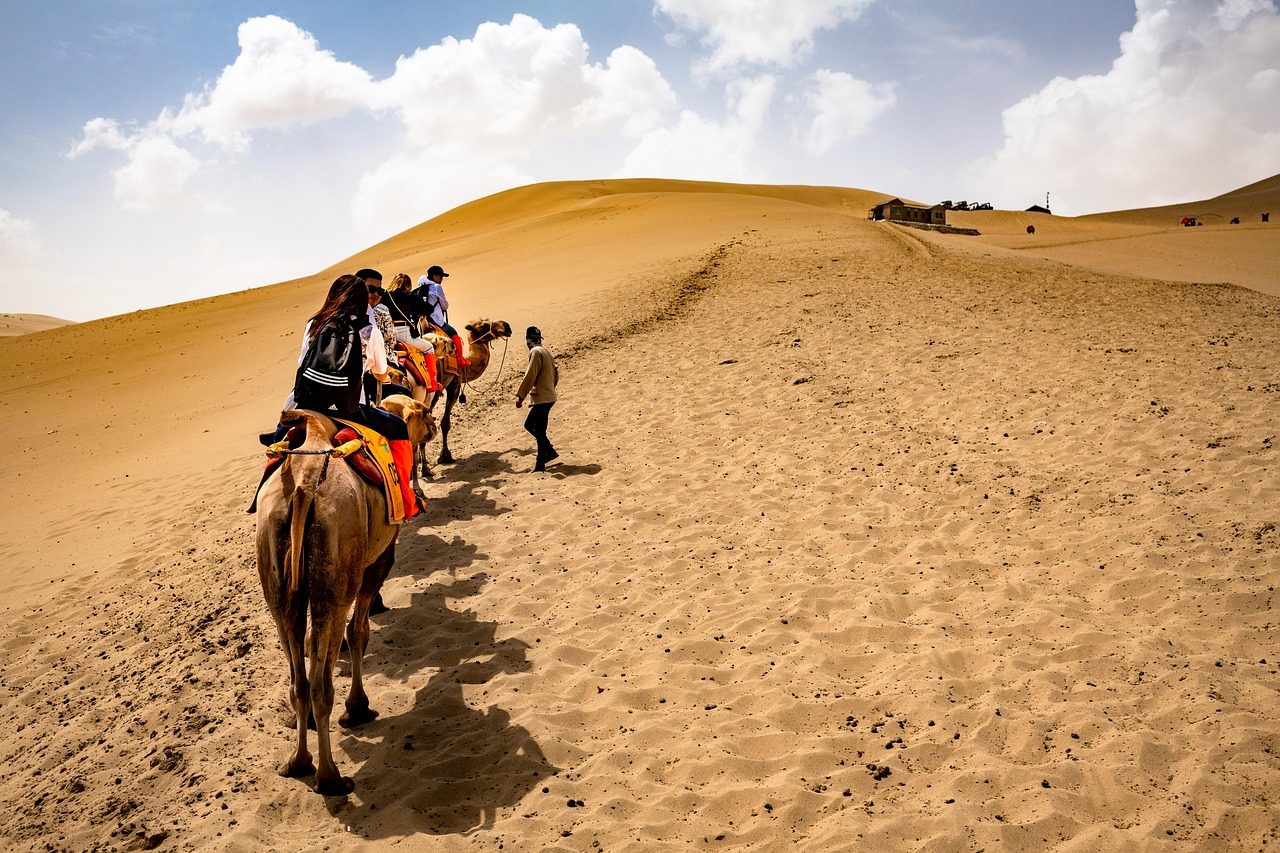
Day 4 — Dunhuang. Two hours at the Mogao Grottoes, two hours at Mingsha Mountain, then Crescent Moon Spring (untimed), closing with 1.5 hours at the Shazhou Food Station heritage-snack night market.
Day 5 — The fortress. A single stop: 1.5 hours at the Jiayuguan Pass fortress.
Day 6 — Zhangye. Three timed stops: 1.5 hours at the Zhangye Rainbow Danxia scenic area, one hour at Zhangye Dafo Temple, and 1.5 hours at Mati Temple.
Day 7 — Qilian Mountains. Four open-ended stops — Zhuoer Mountain, the Qilian Mountain grasslands, the Menyuan rapeseed flower sea and Heiquan Reservoir — with no listed durations; a scenic run to finish.
Trade-offs
The untimed stops are where the schedule flexes. On Day 1, Riyue Mountain and the Qinghai Daotang River scenic area have no listed durations — treat them as short photo stops and guard the timed windows at Ta’er Monastery, Erlangjian and Heimahe Town. On Day 3, if the hour at the Yadan National Geological Park runs long, Hecang City and the Han Dynasty Great Wall ruins are the stops to shorten; Yumen Pass anchors the day. Day 5 lists only Jiayuguan Pass (1.5 hours), which makes it the natural buffer if the Dunhuang days overrun.
Two cuts simplify the plan cleanly. Drop Day 7 — Zhuoer Mountain, the Qilian Mountain grasslands, the Menyuan rapeseed flower sea and Heiquan Reservoir are all untimed scenic stops, and finishing in Zhangye keeps the Dunhuang core and the Hexi Corridor intact for anyone short on days. Within Day 6, Mati Temple (1.5 hours) is the stop to cut if the Rainbow Danxia visit overruns, leaving Dafo Temple and the Danxia park to carry the day; on Day 2, the untimed Delingha Alien Ruins scenic area can be skipped to keep Chaka Salt Lake’s two hours comfortable.